
Extreme weather events are becoming one of the key risk drivers for the insurance industry. A recent study published in Nature Geoscience reveals that Europe is experiencing the strongest increase in very large hail events worldwide.
The study analyzes global trends in hail events with hailstones of at least five centimeters in diameter and their economic impacts since the 1950s. The findings are particularly relevant for insurers, reinsurers, and catastrophe risk modelers.
Key Findings of the Study
Global Hail Climatology
As part of the study, a global hail climatology was compiled using the ERA5 reanalysis. The authors focused on atmospheric conditions that favour very large hailstones of five centimetres in diameter and conducted model training using hail observations and lightning data. Climatological hotspots for hail are shown in Figure 1. According to the study, large hailstones occur most frequently in the Midwestern United States, east of the Andes in northern Argentina, and in South Africa. Other key areas include Australia, parts of tropical Africa and the Mediterranean region.
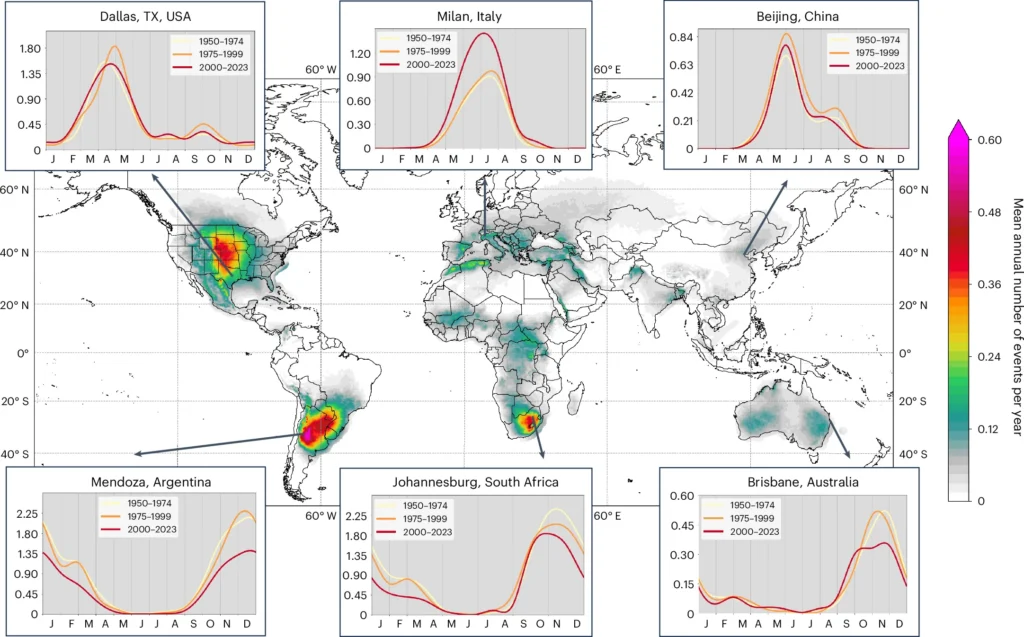
Europe Stands Out Globally
While trends vary significantly across regions, Europe shows a clear pattern:
- Significant increase in very large hail events
- Rising economic losses
- Growing relevance for urban and highly insured regions
The study also highlights that, in Europe, increasing losses are more directly linked to the actual rise in severe hail events than in regions such as the United States or Australia.
Losses Are Not Increasing for the Same Reasons Everywhere
One of the most important findings from an insurance perspective is the distinction between physical hazard and economic exposure.
Europe
Losses are increasing mainly because the physical hazard itself is intensifying.
In other words: severe hail events are becoming more frequent.
United States and Australia
In these regions, increasing insured values, repair costs, and exposure play a larger role than changes in hail frequency itself.
Implications for the Insurance Industry
The study underlines the importance of continuously adapting risk and loss models.
1. Update Risk Models
Historical loss data alone may no longer adequately represent future hail risk.
2. Strengthen Regional Analysis
Hail risk trends differ significantly across Europe, making high-resolution regional modeling increasingly important.
3. Expand Prevention Strategies
Hail-resistant construction methods, protective measures and prevention strategies can help reduce the risk of damage. Policyholders can avoid damage by making use of severe weather warnings.
4. Integrate Climate Risk Strategically
The findings demonstrate that so-called secondary perils such as hail can have major impacts on portfolios and capital requirements.
Conclusion
The study provides strong evidence that hail risk in Europe is undergoing structural change. For insurers, this means:
- Assess climate risks on a regional level
- Distinguish between physical hazard and exposure growth
- Continuously adapt underwriting and catastrophe models
Hail may become an increasingly important component of natural catastrophe risk assessment across Europe in the coming years. MeteoIQ helps insurance companies analyse risks and incorporate recommendations for action into their business operations.
Source:
Battaglioli, F., Taszarek, M., Groenemeijer, P. et al. Contrasting trends in very large hail events and related economic losses across the globe. Nat. Geosci. 19, 52–58 (2026). https://doi.org/10.1038/s41561-025-01868-0